
Find the line
The terminator is the boundary between the lit and unlit halves of the disc. It sweeps across the surface as the phase changes, so a different set of features is dramatically lit every night.
The guide that ships inside every gift package, published here in full. What a crater is made of, which phase reveals what, and the one observing habit that changes everything.
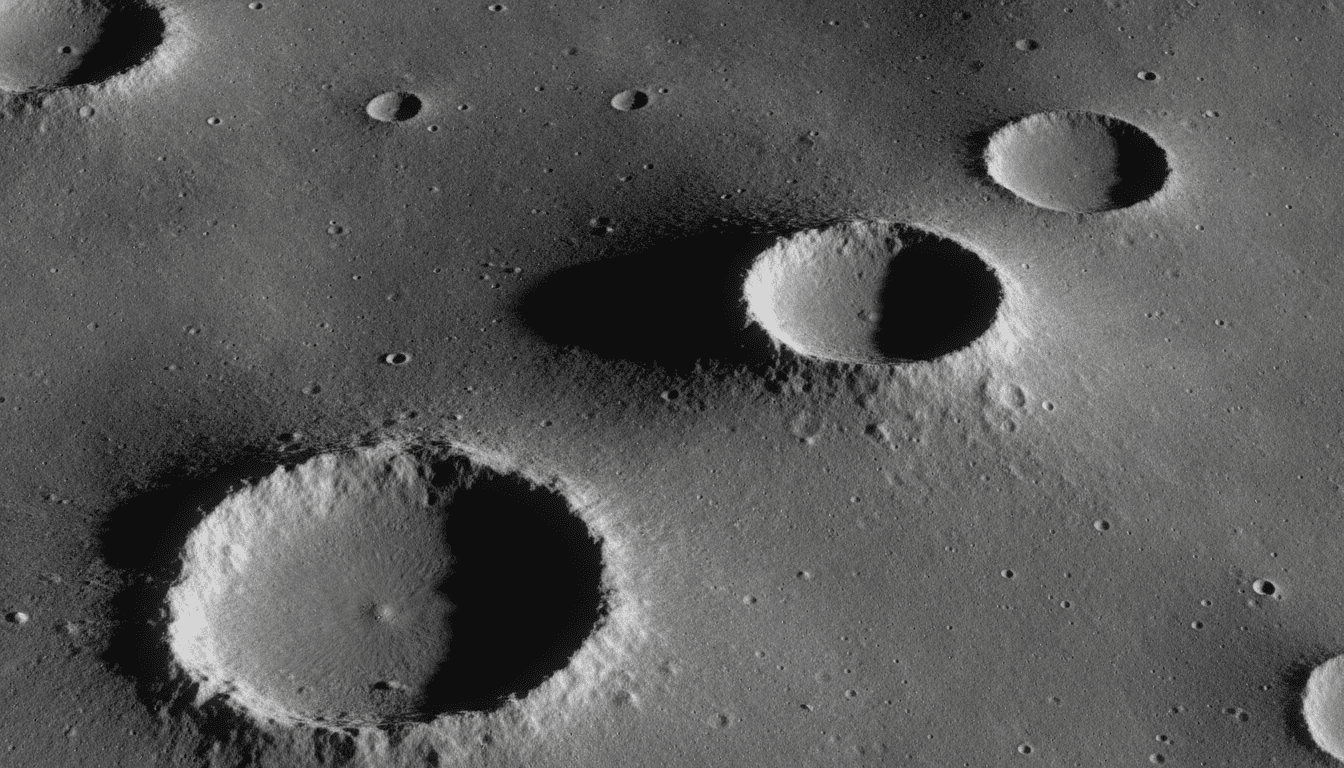
The best time to observe lunar craters is along the terminator, the moving line between lunar day and night, during the first quarter phase. Low-angle sunlight there casts long shadows that make crater rims, central peaks and rilles stand out in sharp relief. A full moon, despite being brightest, is the worst time to look, because direct overhead light flattens every shadow.
Because shadow is what gives you depth. This is the single piece of advice that separates a disappointing first look at the Moon from a memorable one.
The terminator is the boundary between the lit and unlit halves of the disc. It sweeps across the surface as the phase changes, so a different set of features is dramatically lit every night.
Features sitting right on the terminator are caught by sunlight at a grazing angle. Rims throw shadows tens of kilometres long, and a crater that is invisible at full moon becomes unmistakable.
At full moon the Sun is almost directly behind you, so nothing casts a shadow toward Earth. The disc is bright but flat. Save that night for studying ray systems instead.
An impact crater has four features worth knowing: the rim, the floor, the central peak and the ejecta rays. Over billions of years meteoroids, asteroids and comets have struck the Moon at high speed. Because there is no atmosphere, wind or rain, what they carved is still there.
The elevated edge formed by displaced material, called ejecta, thrown outward during the impact.
The bowl-shaped or flat bottom, often filled with cooled lava flow or breccia, the shattered rock welded together by the heat of impact.
Found in larger complex craters. It forms when the deep crust rebounds upward in the seconds immediately following the strike, like a droplet rising from milk.
Bright streaks extending outward across the surface, marking the paths of high-velocity debris. They fade over hundreds of millions of years, so a bright ray system means a young crater.
Learn these three and you have a map in your head. Everything else on the near side can be navigated from them.
The Sea of Tranquility
A dark, smooth basaltic plain formed when lava flooded an ancient impact basin. It is the easiest major feature to find with the naked eye, and on 20 July 1969 it became the site of the Apollo 11 landing. What looks like a sea is solidified rock roughly three and a half billion years old.
Quadrant 2, north-eastern near side
The bright one in the south
A young impact crater about 85 kilometres across, famous for the ray system that fans out from it. Those rays are pulverised rock thrown clear at the moment of impact, and they reach roughly a quarter of the way around the Moon. At full moon Tycho is the obvious bright spot near the bottom of the disc.
Quadrant 3, southern highlands
The classic textbook crater
About 93 kilometres wide and the best example of a complex crater visible from Earth. It has everything the anatomy diagram describes: a terraced rim, a broad flat floor, central peaks rising from the middle, and its own ray system. A small telescope shows the terraces clearly when the terminator is nearby.
Quadrant 1, central-western near side
Plan an observing session using the primary phases of the 29.5-day synodic month. Each phase lights a different part of the disc at a different angle, so each one shows you something the others hide.
| Phase | Lighting angle | Best viewing focus |
|---|---|---|
| Waxing Crescent | Low eastern light | Mare Crisium and the eastern limb |
| First Quarter | Half illuminated | The central meridian and the Sea of Tranquility |
| Waxing Gibbous | High contrast | Copernicus, Tycho and the western maria |
| Full Moon | Direct sunlight, no shadows | Ray systems and colour variation |
| Waning Phases | Low western light | Western crater rims and morning shadows |
Craters in our Terminator tier are chosen because they sit where that shadow line falls at first and last quarter.
This certificate and its accompanying materials are intended strictly as a novelty, symbolic item for educational and entertainment purposes. Under international space treaties, including the 1967 Outer Space Treaty, no individual or entity can claim legal ownership of lunar territory. The Joshua Tree Crater Company operates to support public engagement with astronomy and space conservation.
The craters themselves are real. Every entry in our atlas is a catalogued impact feature with true selenographic coordinates, diameter and depth, drawn from published lunar survey data, and carrying no official name from the International Astronomical Union.
Alongside the certificate, the star chart, the Moon Map, the children’s activity poster and the decal.
